GPLM

Ghost Potential Layer Method

Two-way viscous–potential coupling.
CFD accuracy, a fraction of the cost.

Back to Home

Why GPLM?

Use viscous CFD only where it matters — near the structure. Let potential flow handle the rest.

📉

Fewer Viscous Cells

Drastically reduces the viscous mesh. Only the near-body region needs CFD discretization.

⏱️

Faster Turnaround

Coupling overhead is negligible compared to the viscous solve. Total wall time drops significantly.

🔭

Larger Domain

Potential-flow background extends the effective domain far beyond what is practical with pure CFD.

Compatible viscous solvers:

Star-CCM+ OpenFOAM (in development)

How It Works

Instead of matching fluxes on a control surface, GPLM overlays the viscous domain onto a background potential-flow field.
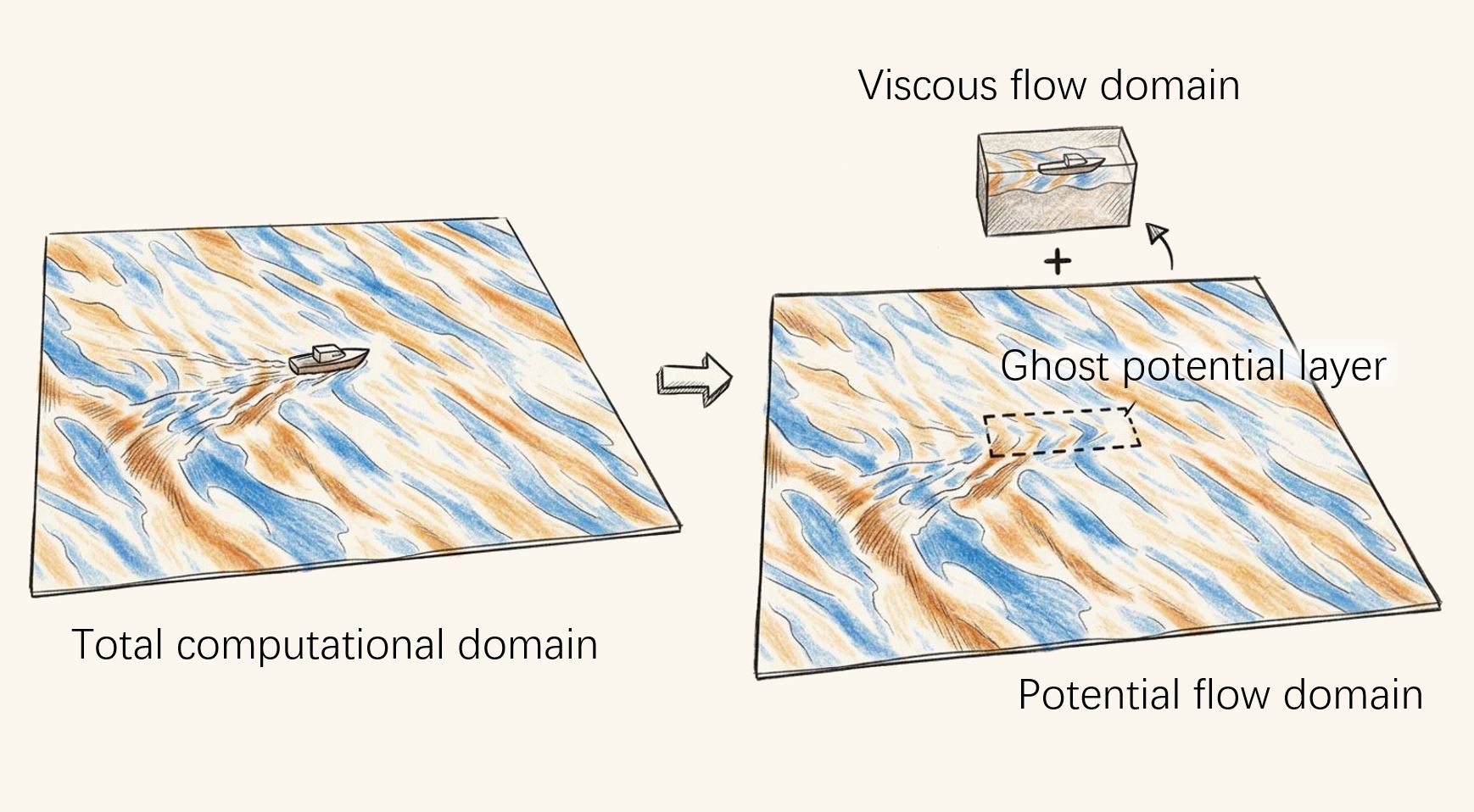
GPLM schematic — viscous domain overlaid on potential-flow background

Overlay, Not Stitching

The viscous domain sits on top of the potential-flow domain. The overlapping potential region is called the Ghost Potential Layer (GPL).

  1. The GPL free surface is iteratively corrected to stay in sync with the viscous solution — transferring waves outward to the potential field.
  2. The potential-flow field provides boundary conditions for the viscous domain — feeding far-field information back in.
  3. This creates a seamless two-way coupling without explicit control-surface flux matching.

Download

  • Potential-Viscous coupling Plugin for Star-CCM+:  click here
  • Potential-Viscous coupling Plugin for OpenFOAM:  coming soon

Contact Us

Inquiries, collaboration, or support:

aeonic@sjtu.edu.cn